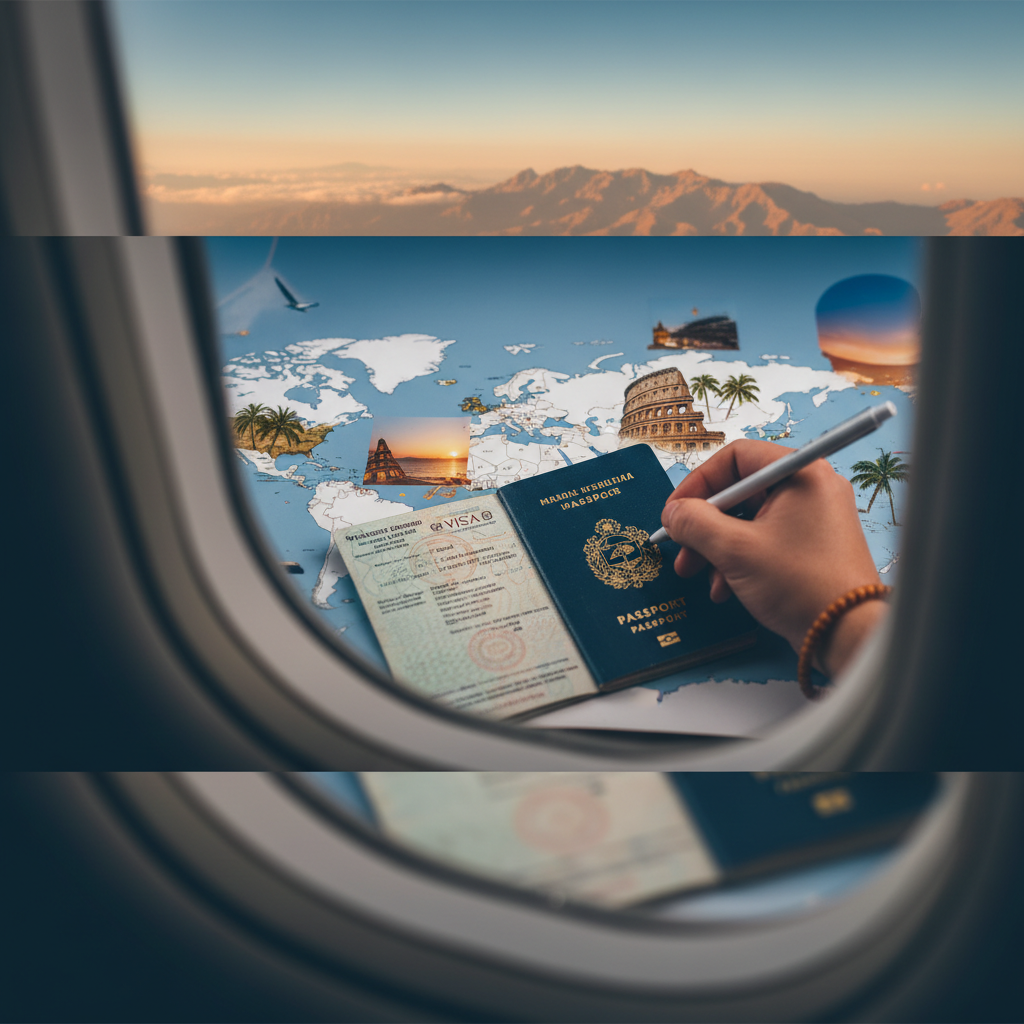
Getting your Schengen visa appointment in La Paz is the first big step for your trip to Europe. This complete guide will walk you through the entire process, from identifying the correct consulate to gathering all...
Getting your Schengen visa appointment in La Paz is the first big step for your trip to Europe. This complete guide will walk you through the entire process, from identifying the correct consulate to gathering all the documents, including the indispensable travel insurance that will open the doors to the old continent.
Complete Guide for Your Schengen Visa Appointment in La Paz, Bolivia
Introduction: What is the Schengen Visa and why do you need it?
The Schengen Area is one of the largest free-movement zones in the world, comprised of 29 European countries that have abolished internal border controls. This means that once you enter one of its member countries, you can travel freely throughout all the others without needing to go through immigration at each border. However, to enjoy this advantage, many travelers need a unified entry authorization: the Schengen visa.
For Bolivian citizens, obtaining a Schengen visa is a mandatory requirement to travel to 29 European countries. This visa is for short stays, generally for tourism, business, or family visits, and allows you to stay in the Schengen Area for a maximum of 90 days within a 180-day period. It is essential to understand that you cannot simply buy a ticket and fly; the visa application process must be completed and approved before your departure from Bolivia.
The first step, and often the most challenging, of this entire process is securing an appointment at the corresponding embassy or consulate in La Paz. Demand for appointments is usually high, especially during holiday seasons, so planning and anticipation are your best allies. This guide is designed to demystify the process and give you the tools to schedule your appointment and prepare a strong and successful application.
Where to apply for a Schengen Visa appointment in La Paz?
One of the most common questions is: "Which embassy should I go to?". The rule is clear and admits no exceptions: you must apply for your visa at the consulate of the country that will be your main destination. This is determined as follows:
- If you visit only one Schengen country: You must apply at the embassy or consulate of that country in Bolivia.
- If you visit several Schengen countries: You must apply at the embassy or consulate of the country where you will spend the most nights. For example, if your trip is 15 days (7 in Italy, 5 in France, and 3 in Germany), your main destination is Italy, and you must apply for the visa at its consulate.
- If you will visit several countries for the same amount of time: In this case, you must apply at the embassy or consulate of the country through which you will first enter the Schengen Area.
It is crucial that you correctly identify your main destination, as submitting the application to the wrong consulate is a cause for automatic rejection. In La Paz, the main diplomatic representations that process Schengen visas are:
- General Consulate of Spain (through BLS International): If your main destination is Spain, the process is not done directly at the consulate. You must schedule your appointment and submit your documents at the BLS International visa application center. They act as official intermediaries.
- Embassy of Germany: If Germany is your main destination, the application is managed directly at the consular section of its embassy in La Paz. You must schedule your appointment through their online system.
- Embassy of France: Like Germany, if France is your main destination, you must request the appointment and submit the documents at the French embassy.
- Embassy of Italy: For trips whose main destination is Italy, the process is carried out at the Italian embassy in La Paz, by prior appointment scheduled through their website.
Comparison: While the German embassy in La Paz directly processes applications, to travel to Spain the process is carried out through the BLS International center. Always check official websites for the most up-to-date information on appointment scheduling procedures, as these can change. Do not trust unofficial intermediaries who promise appointments in exchange for money; the process must be done through authorized channels.
It is also important to mention that some consulates in La Paz represent other Schengen countries that do not have an embassy in Bolivia. For example, the Embassy of Switzerland in La Paz might process visas for Liechtenstein. Always confirm this information on the official website of the consulate of the country you plan to visit.
Step-by-step to schedule your appointment and prepare your documents
Once you know which consulate to go to, it's time to get to work. Following an organized process will minimize stress and increase your chances of success. Here are the key steps:
- Step 1: Access the official portal and create an account. The first step is to visit the website of the consulate or the visa management center (such as BLS for Spain). You will need to create a user profile to access the appointment scheduling system. Have your passport number and personal details at hand.
- Step 2: Select a date and time for your appointment. Appointment availability can be limited. We recommend checking the system frequently, sometimes first thing in the morning or at midnight, as this is when new slots are often released. Be flexible with your dates if possible. Once you find a slot, confirm it and save the appointment notification.
- Step 3: Complete the Schengen visa application form. This is one of the most important documents. Most modern consulates have an online form that you must complete. Fill in each field with truthful information that exactly matches your supporting documents (passport, reservations, etc.). Any discrepancy can raise suspicion and lead to a possible rejection. Upon completion, print the form; you must bring it on the day of your appointment.
- Step 4: Gather all supporting documentation. This is the most laborious part. Consulates need proof that you intend to travel temporarily and that you have the means to do so. Each document has a specific purpose.
Essential documentation for your application:
Although requirements may vary slightly between consulates, this is the list of documents they will almost always ask for:
- Schengen visa application form: Complete, dated, and signed.
- Two recent photographs: Passport size, with white background, without glasses or accessories covering the face. They must comply with ICAO specifications.
- Bolivian passport: Valid for at least three months after the planned departure date from the Schengen Area. It must have at least two blank pages.
- Round-trip flight reservations: Be careful! This is not about the purchased ticket, but a reservation or flight itinerary. Many travel agencies can issue this document for a minimal cost. Do not buy the ticket until your visa is approved.
- Accommodation reservations: Hotel confirmations, tourist apartments (like Airbnb), or an official invitation letter if you will be staying with a relative or friend residing in Europe. The invitation letter must be processed by your host at the local police station in their city of residence in Europe.
- Proof of financial solvency: You must demonstrate that you can afford your trip. This includes bank statements from the last 3 to 6 months, employment certificates stating your salary, latest pay slips, and, if applicable, tax returns. The goal is to show a stable income flow and sufficient funds for your stay (generally calculated at approximately €100 per day of travel).
- Employment or study certificate: If you work, a letter from your employer authorizing your vacation. If you study, a certificate from your university or school. If you own your business, the company registration (NIT, Fundempresa).
- Mandatory Travel Medical Insurance: A crucial document that we will detail below. It must meet very specific requirements. Travel insurance for the Schengen Area is not optional, it is an indispensable condition.
Mandatory travel insurance: a requirement you cannot forget
Of all the required documents, travel insurance is one that generates the most doubts and, at the same time, is one of the most common reasons for visa rejection. Schengen Area consulates do not take this requirement lightly. The lack of valid insurance or insurance that does not meet the minimum conditions will result in an immediate denial of your application.
The insurance must comply, without exception, with the following characteristics:
- Minimum coverage of €30,000 EUR: Or its equivalent in US dollars (approximately $33,000 USD). It is vital that the policy clearly specifies this amount or a higher one.
- Validity throughout the Schengen Area: The insurance must cover you in all 29 countries of the agreement, not just in your main destination.
- Coverage for repatriation and medical expenses: The policy must explicitly cover repatriation for medical reasons, repatriation coverage for funeral, urgent medical assistance, and emergency hospitalization expenses.
- Validity for your entire stay: The insurance must cover from the day you enter until the day you leave the Schengen Area. It is even recommended to buy it with a couple of extra days in case of unforeseen events.
Understanding this need, at Baraglo we have designed a specific plan for visa applicants. A key requirement for the Schengen visa from Bolivia is travel insurance with a minimum coverage of €30,000. Baraglo's Schengen Visa Plan meets this requirement for only $2.99 USD per day. This plan is designed to meet all consular requirements in the most economical and direct way possible, delivering the certificate you need to present at your appointment instantly.
For travelers who seek not only to meet the requirement but also to have superior peace of mind during their European adventure, we offer plans with higher coverages:
| Baraglo Plan |
Medical Coverage |
Price per day (approx.) |
Ideal for |
| Visa Schengen |
€30,000 EUR (Approx. $33,000 USD) |
$2.99 USD |
Meeting the visa requirement economically. |
| Standard |
€32,000 EUR (Approx. $35,000 USD) |
$4.99 USD |
Travelers who want extra security. |
| Essential Plus |
€46,000 EUR (Approx. $50,000 USD) |
$5.29 USD |
Robust peace of mind and coverage for unforeseen events. |
| Premium |
€92,000 EUR (Approx. $100,000 USD) |
$8.99 USD |
Maximum protection and comprehensive coverage. |
Note: Prices are per person. For travelers over 75 years old, a 50% surcharge on the list price applies to ensure adequate coverage.
Do not underestimate this step. Contracting adequate insurance is not only a requirement, it is your safety net. The cost of a Schengen visa application in La Paz is €80, but the cost of a medical emergency in Europe without insurance can exceed €10,000. It is a minimal investment for maximum protection.
Tips for your appointment day in La Paz
The big day has arrived! Punctuality, organization, and honesty are the keys to a smooth appointment. Follow these tips to make the best possible impression on the consular officer.
- Arrive early: Plan to arrive at the consulate or visa center (BLS) about 15-20 minutes early. Arriving late can mean the cancellation of your appointment and having to start the process over.
- Organize your documents: Carry all your papers in a folder, organized according to the consulate's requirements list. Include both originals and a set of photocopies of each. Having everything at hand shows that you are a prepared and serious person.
- Prepare the consular fee payment: The Schengen visa fee is €80 for adults and €40 for children aged 6 to 12. This amount is generally paid in Bolivian Bolivianos (BOB) at the day's exchange rate. Confirm the exact amount and accepted payment method (cash, card) on the consulate's website before going. Bring the exact amount if possible.
- Dress appropriately: You don't need to wear a suit and tie, but casual and neat attire is appropriate. Avoid overly informal clothing like shorts or t-shirts with flashy messages.
- Answer honestly and clearly: The consular officer might ask you some questions about your trip: What is the purpose of your visit? Where are you going to travel? Who is paying for the trip? What do you do in Bolivia? Answer directly, concisely, and, above all, honestly. Your answers must match the information you presented in your documents.
- Stay calm: The officer is not there to deny you the visa, but to verify that you meet the requirements. If you are nervous, take a deep breath. A calm and confident attitude inspires trust.
What happens after the appointment?
Once you submit your documents, have your biometric data taken (fingerprints and photograph), and complete the interview, the waiting process begins. The standard processing time is 15 calendar days, but it can extend up to 45 days in complex cases or during high season. Most visa centers offer an online tracking system where you can check the status of your application with the receipt number they gave you. When the decision is made, you will be notified to pick up your passport. Good luck!
Frequently Asked Questions
How much does a Schengen Visa cost for a Bolivian citizen?
The consular fee for a Schengen visa is €80 for adults. However, this amount may vary and is generally paid in its equivalent in Bolivian Bolivianos on the day of the appointment. Confirm the updated cost on the consulate's website.
How far in advance should I apply for a Schengen Visa appointment in Bolivia?
It is recommended to start the application process at least 6 to 8 weeks before your travel date. Appointment availability can be limited, especially during high season, so plan ahead.
What travel insurance do I need for a Schengen Visa from Bolivia?
You need travel insurance with a minimum coverage of €30,000 that is valid throughout the Schengen Area and covers repatriation. Baraglo's Schengen Visa Plan is specifically designed to meet these requirements affordably.
Can I apply for a Schengen Visa in Santa Cruz?
Yes, several countries also have consulates or visa application centers in Santa Cruz de la Sierra. You should check if the consulate of your main destination country has an office there to carry out the process.
Your trip to Europe is closer than you think. The visa process may seem complicated, but with proper preparation and the correct documents, it is entirely manageable. Ensure your peace of mind and meet the most important requirement. Quote your travel assistance with Baraglo today and get your insurance certificate in minutes.
 Baraglo